


Hello and welcome to The Lancashire Lead.
Andy Burnham will be the next Prime Minister of this country. Whatever your view on that, and how it has come about, it will likely mean we’ve got the first Prime Minister in some time who can point to anywhere in Lancashire (other than Blackpool) on a map with confidence.
In the coming weeks, we will find out exactly what the plans are for the council structure. We know that all 15 lower, upper and combined councils will be scrapped. We do not know whether 2, 3, 4 or 5 combined authorities will replace them and how they will be shaped. We also don’t know their names, though not-so-catchy titles such as Coastal Lancashire and Central Lancashire have been mooted. That’s not unheard of. I edit The Lancashire Lead from South Ribble and it’s a phrase I’ve never used outside of referencing South Ribble Borough Council.
But here’s the thing: Burnham means devolution will be given even more emphasis than before. More powers for local politicians to make decisions is a good thing - but only if those local politicians can finally agree on things. And one thing that would remove that issue is an elected mayor.
Ed Walker has been bending the ears of people in politics and business this week and writes for us on the topic for today’s edition.
Lancashire briefing
🗳️ A leading Pendle councillor has rejected ‘nepotism’ accusations regarding her father re-joining an area committee, despite losing his borough council seat in May.
Lola Whipp, the new deputy leader of Pendle Council, says recent social media accusations of ‘nepotism’ – giving family members unfair influence – are ‘ridiculous’, regarding David Whipp’s return to the West Craven area committee.
On social media, Reform UK’s Pendle and Clitheroe branch asked if the appointment illustrated ‘nepotism or undemocratic behaviour?’ But Lola Whipp has strongly rejected the suggestions.
David Whipp, a veteran councillor and former Pendle Council leader, narrowly lost his borough seat in early May to Reform. He had also been the West Craven area committee chairman until then.
However, Lola Whipp, who is also vice-chairperson of the West Craven committee, has insisted the arrangement follows council rules, is democratic, includes limits on powers, and follows a tradition of having county, borough and parish councillors at area committees.
🍺 After years of debate over the future of a 300-year-old pub that is council-owned, work to tear it down is set to begin.
The Blackamoor Inn in Blackburn has stood witness to the town’s transformation since the 18th century, but after falling empty and becoming dilapidated in more recent times, it is set to be demolished next week.
The former Thwaites pub on the corner of Stopes Brow and Roman Road was closed by the brewery in 2019, after a brief attempt to revive the historic building failed, ultimately leading Blackburn with Darwen Council to purchase the plot for future development.
But fitful plans to convert the derelict building for other purposes fell through, with the local authority ultimately putting in plans to knock the building down in 2024, signalling its intent to mothball the site for a future infrastructure project.
🏊🏻♂️ Skelmersdale could still get a brand-new swimming pool if agreement can be reached despite a major public row last year, a leading councillor believes.
Mark Anderson, the new Labour opposition leader at West Lancashire Council, says finding local agreement for a new Skelmersdale pool will be among among his priorities ahead of a major council shake-up expected in 2028.
And a pool in Ormskirk could get an upgrade too. West Lancashire Council owns the Nye Bevan Pool in Skelmersdale and Park Pool in Ormskirk.
But last year public protests arose over a Labour-backed plan at the time to close both pools before any replacements were built, to save costs.
But then this March, a U-turn followed when other councillors narrowly won a vote to create a £10.5million pot for leisure facilities, along with plans to repair the two pools in the short term.
Unease as Lancashire continues in last place when it comes to devolution
Analysis by Ed Walker
The Devolution train is about to be put on the high speed rail line by conductor Burnham, but in Lancashire it’s yet to even leave the station.
All that may change in the coming weeks as the fate of Lancashire’s councils carve up is decided.
Politicians and council desk jockeys will huff and puff about these being two separate processes, the reality to the average Lancastrian is they are not. It’s all about who can get things done for Lancashire - councils are a catch-all, from parish to county. And it comes down to power and where it sits.
Lancashire’s two-tier, currently three-tier as the combined authority already exists, and four if you include parish councils in many places, is set for being exploded and put back together when the government makes a decision - due before MPs and schools break up on Friday 17 July.
Options on the table range from two uber authorities spanning the North and South of the county, down to five smaller unitary councils, were included in the potential proposals.
Yet whatever decision is made, Lancashire will remain the only place in the North of England without a Mayor or the confirmed prospect of one. In the meantime new figureheads will emerge for these powerful councils formed in most likely three or four powerful blocks and above them will sit a combined authority - meant to direct the strategic priorities of a county - but with no one to align them.
There are some encouraging signs of the Combined Authority beginning to flex its potential muscles - as it met with the government’s Northern Growth Envoy Tom Riordan in the past week with business round-table events taking place.
County councillor Atkinson, who chairs the Combined Authority, is right when he says essentially you can’t treat Lancashire as a mini Liverpool or Manchester: “You can’t build a strategy for the North by looking at one type of place. Lancashire has a different economy, different strengths and different challenges, and that’s exactly why it was important that our voice was part of this conversation.”
Lancashire’s Growth Plan is admirable, but it will be at a local level where it is actually delivered and becomes a reality. It is only when people in Blackburn see a derelict building for decades become something, or a business in Chorley decides to expand does the benefit get felt.
The overall message sent back to the government was ‘give us more Devolution’ and ‘hurry up with it’, but this sits uncomfortably with the apparent Reform-led administration leader’s attitude to elected-Mayor’s and local government reorganisation (essentially, the status quo is fine, we’ll have the powers but no change).
The government’s upcoming decision may just be lighting the touch paper on a more intense version of the squabbling that has come before and seen the Red Rose county lag way behind its geographic neighbours.
Within the business and political communities there’s increasing agitation at the likes of Cumbria and Cheshire stealing a march on the Devolution deals in comparison to what Lancashire has managed to get on the table. Both Cheshire and Cumbria will have a directly-elected Mayoral authority in place by May 2027. In contrast Lancashire will be electing to councils with names remote from their communities and based on a construct (county divisions, such as the snappily titled Preston Central West) that is being eradicated in 2028.
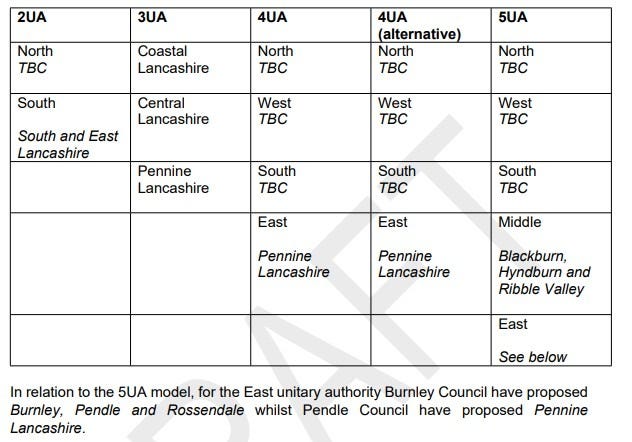
What those new councils will be called remains to be seen - expect that to be a hotly contested debate. Documents released recently as each council gave their response to Whitehall on the consultation give some steer - a three-way carve up of the county has Coastal Lancashire, Central Lancashire and Pennine Lancashire as examples of some of the names being floated.
It means proud and distinct places like Blackpool, Preston, Chorley, Lancaster and Burnley potentially disappearing from the local government map and being replaced by bland, catch all, marketing speak places. And a growing feeling of something being ‘done to the county’ rather than it being the will of the people. That’s a dangerous place for politicians of all colours to end up.