


Good morning and welcome to the Lancashire Lead,
In July, it seemed like the future of Lancashire looked set to be four councils - with the county council one of the authorities due to be on the block to disappear by April 2028.
But a lot can happen in the space of a week in politics, and that makes two months look like a century. Angela Rayner, who has returned to the local government brief and the cabinet under the Burnham government, put the brakes on in September popping up with an announcement that Lancashire, and many other areas of the country, would be ‘pausing’ the process known as local government reorganisation.
We know Stephen Atkinson, who remains a district councillor with Ribble Valley, is no fan of local government reorganisation. He, and others, gave an insight into the thinking of the Reform administration in Lancashire who may join other councils (such as Essex) in challenging the government’s basis for the changes in the courts - through a process known as judicial review.
Thanks to the ever diligent Paul Faulkner, we have an in-depth report into what councillors discussed at County Hall during Thursday’s cabinet meeting - and how the timescale is looking tight for what happens next. There’s plenty of hot air in politics these days (see today’s Lancashire briefing for quite literally some of that from over in Blackburn) but it shows how County Hall does seem to be moving towards taking some kind of legal action.
One thing we think all parties can agree on, is Gina Dowding’s statement that the public was now increasingly “confused” about local government reorganisation. In reality, the majority won’t know until the bins change. But it may end up being payday for lawyers, funded by the taxpayer, on both sides.
Lancashire briefing
💨 A Reform UK councillor has been accused of farting at another politician during a meeting at Blackburn with Darwen Council.
Around halfway into Thursday night’s four-hour council forum, a motion was briefly interrupted by a much louder motion that could be heard on the other side of the town hall chamber.
Fingers were pointed at Reform UK Councillor for Blackburn South East Andy Mahon, who was wearing a distinctive leopard print fedora and matching tie paired with a safari jacket, an outfit which would not have looked out of place in the Serengeti.
While the resounding flatulence was just a brief moment in a meeting that ranged from public questions to monthly updates from the executive, towards the end of the forum one councillor felt the need to speak up.
Cllr Tasleem Fazal, a member of the 4BwD group sitting across the aisle from Cllr Mahon, challenged the behaviour, saying: “What I do take issue with is the decorum in here of late and especially this evening.
“As elected members, we all respect one another’s positions; we’re all here on merit. But we have to respect one another also.”. Full story in the Lancashire Telegraph, thanks to Will Morgan.
📝 Reform-led Derbyshire County Council bans Derbyshire Live’s Local Democracy Reporter.
While this isn’t Derbyshire, we wanted to highlight how yet again a Reform-led administration is attempting to muzzle a free press.
This has made national headlines, quite rightly, and we send our solidarity to Eddie Bisknell and the team at DerbyshireLive and the Derby Telegraph. As today’s edition shows, with Paul’s as always superb work, the public rely on reporters being not just present in the chambers of power but also able to ask questions.
Of course politicians, and government officials, will have views about stories, headlines and wording - but the continued attempt to try and block and control what journalists do is becoming an increasingly worrying trend. The attempt by the administration there to claim it isn’t a ban, has made a bad situation even worse.
🏨A Central Lancashire hotel that has been used as accommodation for asylum seekers for almost five years will be vacated by the end of December.
The Leyland Hotel, on Leyland Way, was one of more than 400 facilities previously taken over by government contractors to house people while their applications for asylum were being processed.
The 93-room venue – officially known as the Preston Leyland Hotel – closed to the public in April 2022. Government correspondence says it will stop being used as an asylum facility “before the end of the year”.
South Ribble’s MP Paul Foster said had been assured by the Home Office that those currently living in the hotel would be moved to “proper asylum facilities” – and not dispersed into houses of multiple occupation (HMOs) locally. He previously revealed that the site had been used to accommodate families and single mothers, not lone males.
The Labour politician last year urged the government to set a timetable for the closure of the asylum centre in his constituency, which – in its previous guise – was one of the of the few hotels in the Leyland area and also a popular wedding venue.
Shifting deadlines, legal threats and confusion - inside what’s happening with local government reorganisation in Lancashire
by Paul Faulkner
Lancashire County Council could launch legal proceedings against the government after being left in the dark about the nature of an unexpected pause in plans for a radical local authority shake-up.
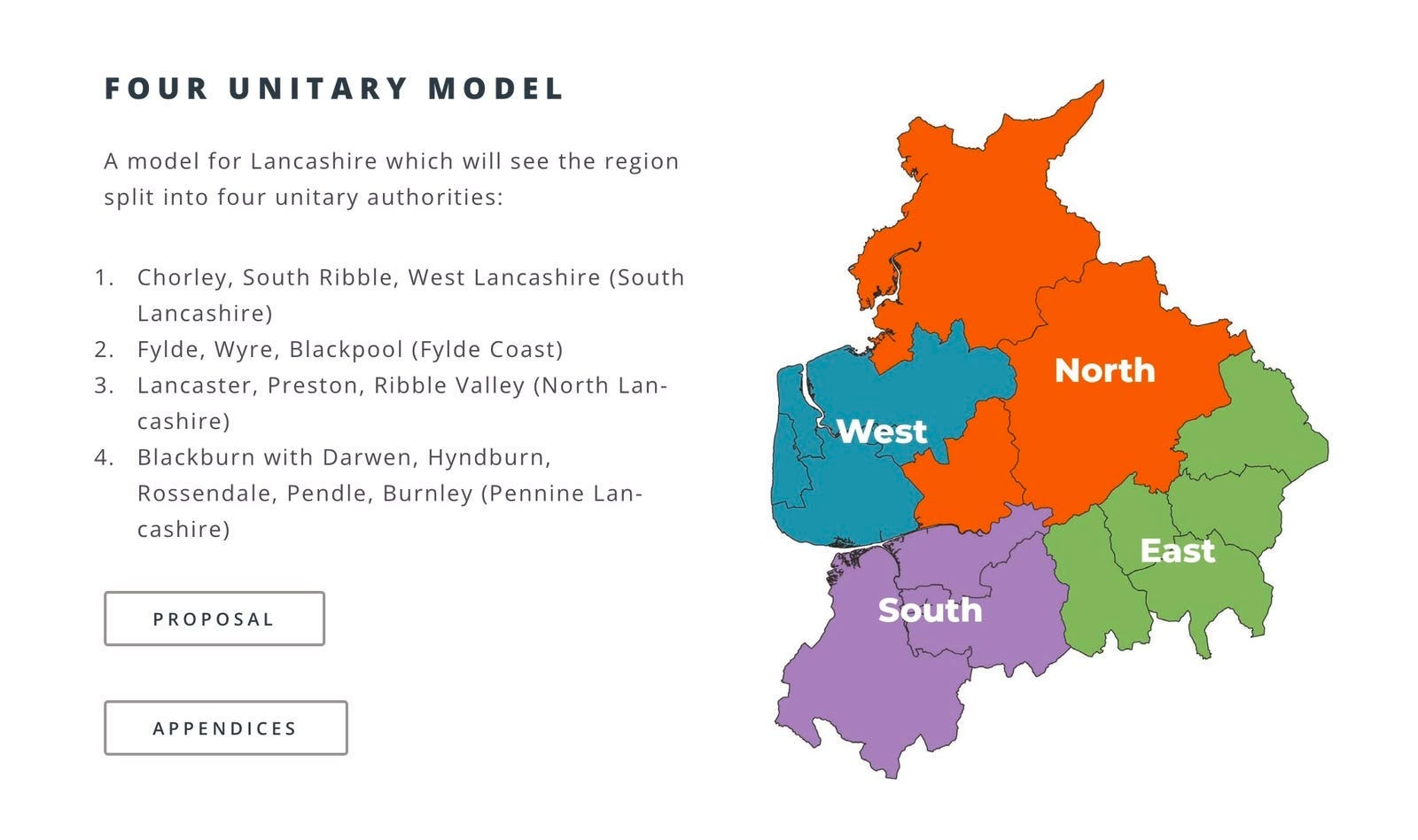
Ministers revealed in mid-July that they had chosen to carve Lancashire into four new council areas as part of a controversial streamlining programme that will see its 15 main authorities - including the county council - scrapped.
However, on 7th September, the government made the shock announcement that the long-established timetable for the transition to the new councils was being ripped up while it checked whether the process it had followed was lawful.
It has now emerged that the county council had already been seeking details about the evidence on which the decision to create the four new Lancashire authorities had been based, in order to decide whether to challenge it via a judicial review.
The chosen four-way split was one of five options Lancashire’s existing councils had put forward - in answer to a government call for them to set out their preferences - all of which were assessed by the Ministry of Housing, Communities and Local Government (MHCLG).
The others would have seen Lancashire cut into either two, three or five new local authority areas - or an alternative four-configuration to the one that was ultimately selected.
Any of the current councils that want to contest the basis for the government’s decision have exactly three months from the date it was announced - on 16th July - to mount a judicial review.
However, a county council cabinet meeting on Thursday heard that the authority had been trying to establish whether that clock was still ticking in the wake of last month’s sudden pause.
The answer hinges on whether the government has formally ditched the decision it announced in July and restarted the process from scratch - reassessing each of the proposals before coming to a fresh conclusion - or is simply planning to more fully justify its original choice.
Local government secretary Angela Rayner said in the Commons last month that Lancashire’s council overhaul was one of 14 revamps taking place nationwide that would be subject to a “review”. Meanwhile, she said she would “withdraw” decisions in relation to four others, where some of the councils concerned had already set out a legal challenge - giving that group more clear-cut certainty.
Lancashire County Council cabinet members heard that a 17th September letter from leader Stephen Atkinson to devolution minister Jim McMahon - seeking clarification on whether the review will involve a “reconsideration of all proposals” put forward by Lancashire’s authorities - had gone unanswered.
The issue was raised again during an already-scheduled face-to-face meeting between the pair five days later - and followed up in further correspondence and requests from County Hall officers during the last week of September. But no response to the key question has been provided.
If the government declares after 16th October that it is standing by its July decision - without having gone back to the drawing board to issue it anew - the county council will have missed its opportunity to seek a judicial review, should it then want to do so.
The situation is further complicated by the fact that the MHCLG has also refused to release the rationale for its original conclusion.
Against that backdrop, the county council’s cabinet voted to permit County Cllr Atkinson and the authority’s senior officers to seek an extension - a so-called ‘stay’ - to the three-month time limit for a legal challenge, should it be deemed necessary in the coming days.
A report presented to the meeting stated that a successful “protective claim” would “preserve the council’s ability to challenge the July decision if necessary”, beyond the mid-October deadline - without committing it to actually doing so until it has seen the outcome of the government’s review.
Recommending that the Reform UK-run authority move to keep its legal options open, County Cllr Atkinson said it “protects the council’s position [and] affords maximum flexibility and minimal costs”, which a cabinet report estimated would be in the region of £5,000.
He added: “We’ve tried to engage constructively with the government - and we tried to build trust with [them].
“I have spoken directly with the Secretary of State and the minister. We’ve always tried to have a respectful conversation, but unfortunately, the legal process is driving us against the statutory time limit.
“We’ve been told we will get a letter back [from the government] every day now for about the last five days.
“We will continue to act carefully, responsibly and in the best interests of Lancashire’s residents, communities, staff and partners.”
Gina Dowding, deputy leader of the Progressive Lancashire main opposition group, warned that the public was now increasingly “confused” about the local government reorganisation process.
