


Hello and welcome to The Lancashire Lead.
It was fitting that a meeting to set Lancashire down the road to an elected mayor was cancelled - and then days later a release dropped about the multi-billion pound pipeline of investment opportunities for the North.
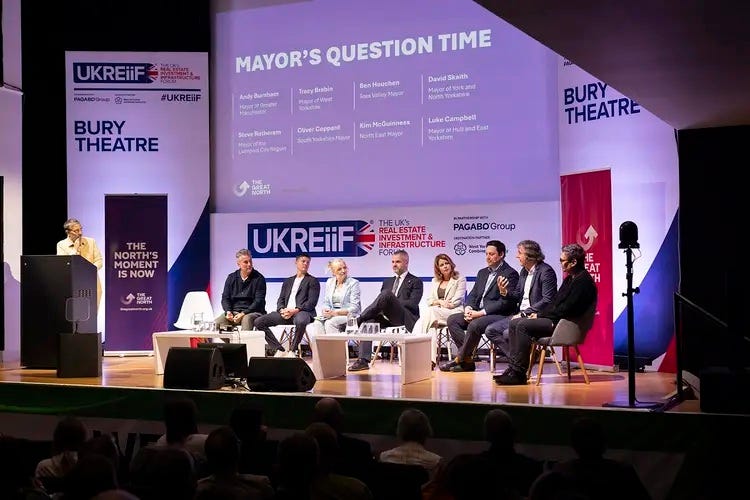
The Great North Investment Summit set out some wonderful plans this week - if you live in basically anywhere in the north that’s not Lancashire.
And unfortunately, while Lancashire County Council were invited to the table and helped to promote the investment, there’s no getting around the fact that The Great North describes itself as a mayoral-led partnership. Little surprise then, that nobody could tell The Lancashire Lead what’s in it for us.
Today’s edition looks at the delays to the mayoral process in Lancashire and then scroll to the end to get my analysis about what it actually means for the county.
In good news, The Lead’s local network - which includes us - has been nominated for Best Local & Community Newsletter at the Publisher Newsletter Awards 2026. It is judge-led, rather than votes, but thank you for your continued support. The best way to keep it going is to take a paid subscription.

Lancashire briefing
🗳️ The Green Party has won a Lancaster City Council by-election, retaining its strong presence in the area amid wide political changes across Lancashire and beyond. Will Farley has been elected to the city council with 845 votes, followed by the Labour Party in second place, Reform UK in third and the Lib Dems fourth. The Conservatives did not stand in this by-election. The full results, in order of the number of votes gained, are Will Farley (Green) 845, William David Evans (Labour) 190 votes, Marco Wright (Reform UK) 132 and Malcolm Allan Martin (Lib Dem) 41. The Green Party’s result was over 300 votes higher than in the last Castle ward by-election of 2024. Speaking about the Green victory, new councillor Will Farley, who lives in the ward, said: “I’m extremely proud that the people of Lancaster have continued to put their faith in the Green Party. We will build on the standards that many of you have come to expect – and also prove ourselves to those of you who believe we can do more. “I’ve had so many interesting conversations with people across the campaign, some of whom are completely apathetic to voting, others sceptical of the Green Party. Yet when people come together and talk about what we have in common, the results can be surprising. There are few people who would suggest that the UK is not facing many crises – but divisive politics ultimately only works to the detriment of our communities. “This campaign has proved to me that, despite the news headlines and the constant feed of despair in our social media algorithms, when people talk to each other, not at each other, we can build on what we share in common rather than only fight over what divides us. And, together, we can work to improve people’s lives. “Whether on a national or local level, we need to remember how to talk with one another, solve problems together and ultimately do our job as elected officials. That job is to serve our community – and not to prove that any sole party has all the answers.”
🌹 Preston City Council will be run by a minority Labour administration after the authority’s leader was re-elected to his post. Matthew Brown retained the top job after a meeting on Thursday which saw him fend off a challenge for the role from Liberal Democrat opposition group leader John Potter. It means the group will always now need the backing or abstention of four non-Labour councillors to be sure of being able to pursue its policies – as it did to re-elect Cllr Brown. Following the vote, Cllr Brown said: “Rumours of my political death have been greatly exaggerated – so here I am again.” He also declared that there had been “absolutely no deals with anyone here” – prompting jeers and laughter from the Liberal Democrat contingent. That wry mirth came in the wake of earlier votes for the chairs of the authority’s two scrutiny committees. Cllr Brown said the scrutiny function at the city council had “traditionally always gone to opposition politicians, [but] we just think there’s better opposition politicians to do it”.
🚧 Lancashire County Council has announced it will spend an extra £5m on road maintenance over the next 12 months. The Reform UK-run authority says the additional funding will focus on “preventative” treatments designed to “accelerate improvements” in the condition of the road network. That means the money will be poured into pre-planned surface upgrades covering substantial stretches of highway, rather than spent filling individual potholes as they appear. The authority’s leader, Stephen Atkinson, said it was part of a planned transformation of the highways service. Progressive Lancashire opposition group leader Azhar Ali welcomed the investment, but called for engagement with county councillors over decisions about where the cash is spent. “People always question, ‘Why was it this road and not the other [that has been resurfaced]?’” County Cllr Ali said. “I think…that [some] discussion would instil confidence in the elected members, [who] would also then be able to explain [the situation] to the members of the public.” However, cabinet member for highways and transport Warren Goldsworthy said spending would not be a matter of choice – but the result of a “data-driven” process.
Left behind: Lancashire will be last area in the north without a mayor
By Paul Faulkner
A meeting that could finally have put Lancashire on the road to getting an elected mayor was cancelled last week – for the second time in as many months.
It is understood that the plug was pulled on the crunch gathering – between local authority leaders and the government – which had been due to take place in Whitehall on 12 May.
It was called off because the State Opening of Parliament had subsequently been scheduled for the following day. But political turmoil would have torpedoed the talks in any case after the government minister who was set to lead them resigned hours before they were due to begin.
Devolution minister Miatta Fahnbulleh quit on the morning the meeting had been planned, as she became the first member of Prime Minister Sir Keir Starmer’s team to walk out over his leadership.
Her departure means Lancashire has lost the key government contact with whom it has been negotiating the next steps on its devolution journey since last September – a period during which there have been substantial developments, including a demand for a guaranteed £1bn investment package for Lancashire over the next three decades to go with any mayor.
Last week’s meeting had been scheduled to enable the leaders and chief executives of the county’s three top-tier local authorities – Lancashire County Council, Blackpool Council and Blackburn with Darwen Council – to discuss with Ms. Fahnbulleh how Lancashire might move towards the creation of an Andy-Burnham type figurehead.
The event – which would also have been attended by officials from the Ministry of Housing, Communities and Local Government – had originally been scheduled for March, but had already been cancelled once at the request of the government, because of the timing of Parliamentary business. The LDRS understands no new date has been set for Lancashire’s representatives to meet with the newly-appointed devolution minister, Nesil Caliskan MP.
It is unclear whether the ongoing leadership speculation surrounding the Prime Minister will delay work within the government on Lancashire’s devolution progress – or provide an impetus to speed it up.
The cancelled meeting had been set to revolve around a series of requests previously made by the trio of council leaders who would have been in attendance – as well as consideration of the outcome of a local “governance review” of Lancashire’s devolution arrangements.
In unpublished correspondence sent shortly before Christmas, Lancashire County Council’s Reform UK leader Stephen Atkinson and the respective Labour leaders of Blackpool and Blackburn with Darwen councils, Lynn Williams and Phil Riley committed to exploring “the principle” of a mayor-led system for Lancashire.
However, what they described as their willingness to “engage positively” over the subject was set out as being “contingent” on confirmation of the funding that would come with the post, the timescale for the introduction of the role and the outcome of a public consultation into the new set-up.
The three also formally floated the idea – previously mooted by County Cllr Atkinson, a longstanding opponent of elected mayors as part of the devolution process – of Lancashire being able to access that mayoral finance before the new, all-powerful politician is actually in place.
The three politicians sit together at the helm of the Lancashire Combined County Authority (LCCA) as the heads of its constituent councils.
That organisation was established in February 2025 to oversee the implementation of Lancashire’s existing devolution deal. The agreement did not include an elected mayor – a prospect that has proved politically controversial in the county throughout what is now a decade of wrangling between all 15 main Lancashire councils over the issue.
Devolution is the process by which local areas are handed powers that were previously the preserve of central government – and funding to accompany their new responsibilities.
The letter sent to the government in December was the latest response to a ministerial demand for the LCCA to bring forward plans for “deeper” devolution – widely interpreted as code for moving to a mayoral model and securing the additional cash and powers that the post would bring, including over some elements of transport, housing and economic development.
The top-tier council leaders, in their roles as constituent members of the LCCA, resolved in October to consider introducing a mayor – but only if “clear and substantial benefits” could be demonstrated by the government beforehand.
County Cllr Atkinson was particularly keen to establish exactly how much additional funding would come Lancashire’s way if it took the mayoral route favoured by ministers.
In reply, Ms Fahnbulleh stressed that a commitment to mayoral authority funding being delivered over a 30-year period was laid down in legislation – but would not be drawn on specifics. She said the amount available to Lancashire would be “subject to further decisions following consideration of the Combined County Authority’s proposal to pursue mayoral devolution”.
In their December correspondence, the LCCA members once again attempted to secure a government commitment to a precise figure for a Lancashire mayoral ‘investment fund’, stating that their “fiscal assumption is that this would be in excess of £1bn, or [circa] £36m per annum, when gauged against [those] which have been agreed for other new or emerging Mayoral Strategic Authorities”.
They also noted in other areas working towards an elected mayor that the government now wanted the new role introduced only after completion of any separate changes to streamline the local council set-up in those places. Lancashire is poised to undergo such an overhaul in April 2028, when its existing 15 local authorities will be abolished and replaced with an as-yet-undetermined smaller number of councils.
Against that backdrop – and the resultant minimum two-year wait for any elected mayor that is ultimately agreed for Lancashire – the LCCA said it believes there is “merit in releasing 50 percent of [any mayoral] investment to Lancashire earlier in the process [in order] to create new opportunities to maximise the benefit of existing resources, with the balance available in full when a mayor is in place”.
The letter also highlighted what its authors described as “the unique position which Lancashire now faces regarding reduced levels of capital investment and [combined authority] capacity funding, as one of only two non-mayoral CCAs in the country”.
Meanwhile, on the subject of a public consultation over an elected mayor for Lancashire, the LCCA members stated their desire to “ensure that the views of Lancashire’s residents and stakeholders are fully considered”.
Last week’s gathering would have seen the government respond to the county’s raft of requests – a duty now set to fall to Nesil Caliskan at a later date. She becomes the third person to occupy the post of devolution and local government minister since Labour came to power in 2024, after the original officer-holder, Jim McMahon, was shuffled out of the job last September.
Lancashire is currently the only part of the North of England neither to have an elected mayor nor be formally en route to installing one.
County Cllr Atkinson said back in November that he believes a mayor actually “centralises power” – and so is at odds with the essence of devolution. He also said he wanted Lancashire to “understand exactly what we will get” out of the arrangement before signing up to it.
However, Cllr Riley said it would be “insane for Lancashire to end up being the only place in the North of England that doesn’t have a mayoral authority – it makes absolutely no sense whatsoever”.
Cllr Williams added that the county was “missing opportunities” by not being led by a mayor – and that it had “a lot of catching up to…do” with Greater Manchester and the Liverpool City Region.
Further delays to mayoral process means Lancashire loses out - rightly or wrongly
Analysis by Luke Beardsworth
In basic terms, it’s not a stretch to imagine that most people do not care whether Lancashire has a mayor or not. If and when it happens, it won’t be quick and anything other than an incredibly combative election period is unthinkable in 2026.